
In India’s modern furniture and modular kitchen market, moisture-resistant engineered boards are now replacing traditional plywood. Two leading products in this space are Merino Marine Board and Greenlam’s MFC HMR Chipboard.
Both promise superior performance, but they differ in construction, finish, and best-use cases. Let’s break it down in detail.
Table of Contents
1. Product Overview
Merino Marine Board – “Naye Bharat Ka Naya Board”
Merino’s Marine Board is a next-generation engineered board designed to perform in high moisture and damp conditions.
It’s not marine plywood, but a high-performance composite board with excellent warp resistance, screw holding, and shape retention.
The board comes with a 12-year warranty, making it ideal for modular furniture, bathroom vanities, and kitchen cabinets.
Key Highlights:
- High Moisture Resistance (HMR technology)
- Warp-resistant and dimensionally stable
- Excellent screw-holding capacity
- Anti-bacterial and eco-friendly
- Safe for interiors (does not release harmful gases)
- Termite-resistant and easy to paint
- 12 years warranty
Greenlam MFC HMR Chipboard – HydraStrong Technology
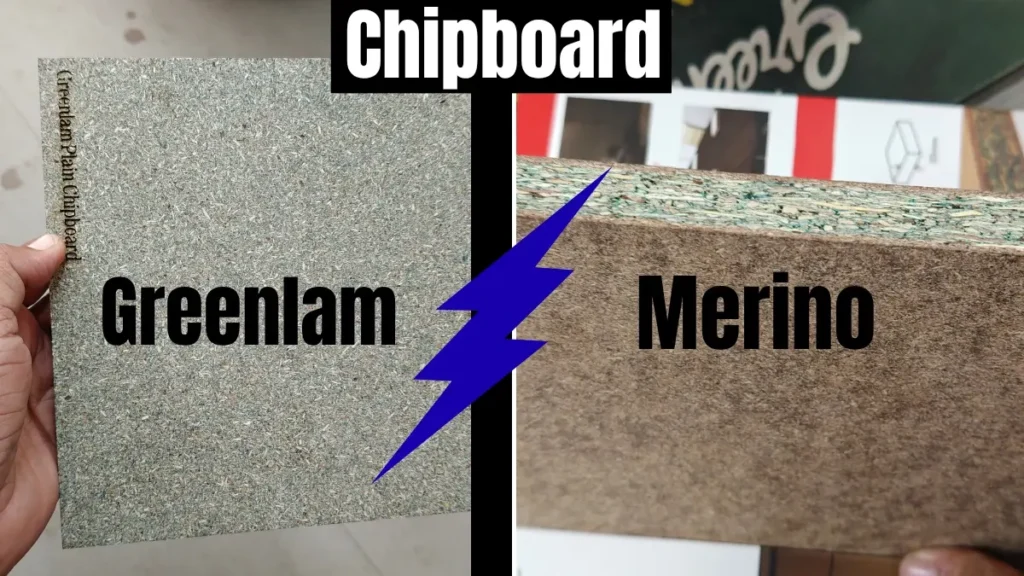
Greenlam’s HydraStrong MFC HMR Chipboard is a Melamine Faced Chipboard that combines moisture resistance with ready-to-use decorative surfaces.
The “MFC” means Melamine Faced Chipboard, and “HMR” refers to High Moisture Resistant. It’s built for style and strength within, perfect for modular kitchens, wardrobes, and office furniture.
Key Highlights:
- Pre-laminated decorative surface (ready-to-install)
- Moisture and termite resistant core
- Smooth, scratch-resistant finish
- Anti-bacterial surface
- Available in multiple colours and textures
- 12-year warranty by Greenlam
2. Technical Comparison Table
| Feature | Merino Marine Board | Greenlam MFC HMR Chipboard |
| Base Material | Engineered HMR board | Melamine Faced Chipboard |
| Surface | Plain (paintable / laminable) | Pre-laminated decorative surface |
| Moisture Resistance | High (HMR technology) | High (HMR core) |
| Termite & Borer Resistance | Yes | Yes |
| Screw Holding Capacity | Excellent | Moderate |
| Warp Resistance | Very good | Moderate |
| Paint / Laminate Application | Easy to paint or laminate | Already pre-laminated |
| Ideal Use | Wet-area furniture, bathroom cabinets, kitchens | Modular furniture, wardrobes, offices |
| Aesthetic Options | Requires paint or laminate | Available in many textures |
| Warranty | 12 years | 12 years |
| Made by | Merino | Greenlam |
3. Moisture & Durability Performance
- Merino Marine Board:
Specifically engineered for high humidity and damp conditions, the board does not swell easily and retains its shape. Perfect for bathroom furniture, kitchen under-sink cabinets, and coastal homes. The edge must be sealed properly. - Greenlam MFC HMR:
Great for moderate moisture like kitchen and bedroom environments. However, its edges must be sealed properly to avoid swelling.
Winner: Both Merino Marine Board and Greenlam MFC HMR chipboard
4. Strength & Screw Holding
- Merino Marine Board:
Good for fixed furniture, making it ideal for modular furniture that needs repeated assembly/disassembly or heavy fittings. - Greenlam MFC HMR:
Offers superior screw holding, ideal for heavy-duty applications requiring multiple screw fixings.
Winner: Greenlam MFC HMR Chipboard (better for carpenters & modular manufacturers).
5. Finish & Aesthetic Appeal
- Merino Marine Board:
Plain surface — you can paint, laminate, or finish it as per your design. Offers flexibility in custom interiors. - Greenlam MFC HMR:
Already pre-laminated with decorative finishes. Available in woodgrain, matte, or glossy surfaces — saves time and labour.
Winner: Greenlam MFC HMR (if you want a ready-to-use decorative finish).
6. Termite & Eco Safety
Both products are treated to resist termites and are safe for indoor environments.
- Merino Marine Board: Safe, formaldehyde-compliant, and eco-conscious.
- Greenlam MFC HMR: Certified anti-bacterial and non-toxic surface.
Tie: Both brands ensure indoor safety and protection.
7. Cost Factor
- Merino Marine Board:
Slightly costlier due to higher density and versatile finishing options. - Greenlam MFC HMR Chipboard:
Economical for large furniture projects since it’s pre-laminated.
Winner: Depends on project type.
For budget projects → Greenlam MFC HMR.
For premium moisture zones → Merino Marine Board.
8. Recommended Usage
| Area | Best Option |
| Kitchen under-sink cabinets | Merino Marine Board |
| Bathroom vanities | Merino Marine Board |
| Wardrobes | Greenlam MFC HMR |
| Office furniture | Greenlam MFC HMR |
| Painted or customized furniture | Merino Marine Board |
| Quick modular projects | Greenlam MFC HMR |
Final Verdict
In Merino Marine Board vs Greenlam MFC HMR Chipboard, we find out that both are modern, high-moisture-resistant engineered panels — but they serve different purposes:
- Choose Merino Marine Board when you need durability, moisture protection, and customization (paint or laminate as per design).
- Choose Greenlam MFC HMR when you want a ready-made decorative board for quick installation.
If your priority is long life and moisture-proof performance, the Merino Marine Board clearly wins for heavy-duty interiors. These HMR Chipboards are surely gonna be the next big thing in the plywood market. Currently HDHMR board are selling like nothing; plywood always has tough competition from them.
Pros & Cons (summary)
Merino Marine Board
Pros: Excellent water resistance, strong structural properties, long life in harsh environments.
Cons: Higher cost, usually requires finishing (veneers/laminates) for final look, heavier.
Greenlam MFC HMR Chipboard
Pros: Pre-finished surface, cost-effective, moisture-resistant for interiors, hygienic surface options, faster installation.
Cons: Not for continuous immersion, lower screw-holding vs plywood, edges need protection in wet zones.
Frequently Asked Questions (FAQ)
Are marine boards always plywood?
Most marine-grade boards are plywood constructed with multiple veneers and waterproof adhesives, but there are also composite marine panels; always check manufacturer’s specs.
Which is more eco-friendly?
Eco credentials depend on the source of wood fibres, the adhesives (low-formaldehyde E0/E1 ratings), and manufacturing practices. Check certifications such as FSC, E0/E1, ISO, or other sustainability marks.


Very informative comparison! This guide clearly explains the differences between Merino Marine Board and Greenlam MFC HMR Chipboard, making it much easier to choose the right material for interiors. Great work!